
Palm Sunday
Family Quiz: Why is this Sunday called Palm Sunday?
(Answer: Because the crowd greets Jesus with palms, like a hero.)
Jesus’ Actions
Jesus rides into Jerusalem on a donkey.
Family Activity: Talk about it.
- Have you ever been to a baseball or football game at a large stadium with a sell-out crowd? Have you been to a concert, parade, or even a theme park such as Disneyland where the crowds were huge, where you were trying to get a glimpse of the “main act?”
- On Palm Sunday, as throughout our celebrations of Holy Week, Jesus is the “main act.” Imagine the scene as Jesus rides through a huge crowd on the road into Jerusalem.
- Why did they turn out to welcome him, to sing his praises as King?
Our Symbol: Palm
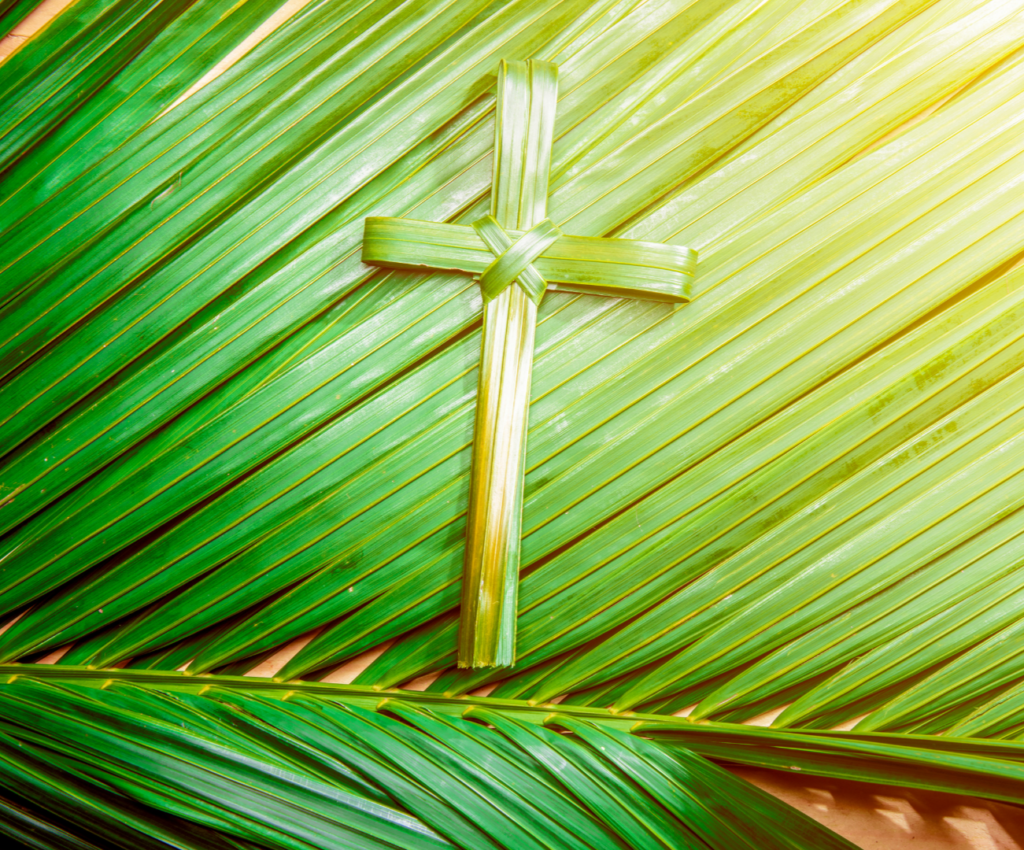
The people of Jerusalem welcome Jesus with palms. Why palms? Palm-bearing date trees were valued for their dignity, beauty, and shade. Palms were a symbol of victory and sign that “all is well.” They were used at special occasions to welcome heroes and royalty. So no wonder the people greeted Jesus waving palm branches. After all, wasn’t he the hero who was going to save them from the oppressive rule of the Romans?
They sing Hosannah to the King.
Family Activity
Bring home palm branches from your Church’s celebration today. Arrange the branches on your Lenten prayer space, or weave them through your home cross or other religious symbols which hang on the wall.
Listen to the Word
The liturgy the family will experience today has a bonus: two Gospels. The first describes Jesus’ entrance into Jerusalem. The second Gospel is the Passion. The Passion narrative tells the story of Jesus being captured, sentenced to death, and dying on a cross.
Family Activity
Prepare as a family before going to Mass today. Each family member has an assignment as they listen to this Sunday’s Gospel readings:
- Preschool children: bring crayons and paper for them. Ask them to draw pictures of the different things they see in Church today—the palms, the cross, etc.
- Children, youth and adults: throughout the Gospel readings, imagine yourselves as a part of the crowd, and imagine yourselves as Jesus.
- What are you thinking?
- What are you feeling?
- What would you do if you were Jesus’ best friend?
After Mass, be sure to share with each other your answers to these questions.
Prayer for Palm Sunday
Wondrous God, your Son, Jesus was so humble. He always put others first. He obeyed you, and even died on a cross. Then you gave him the highest place. We honor his name above all others. Bless our family as we begin Holy Week. Help us to be a family who prays together this week and who welcomes Jesus into our hearts. We pray this is Jesus’ name.
Amen.
Spiritual Reflection
Today the Gospel reading for the blessing of the Palms gives us a glimpse of Jesus’ majesty. The people wave palm branches and sing “Hosannah to the King.”
As a family, reflect on your experience of Palm Sunday this year. In particular, reflect on the entrance of Jesus into Jerusalem. Use these questions to guide your reflection:
- Where do we see Jesus’ majesty in our home, in our community, in the world?
- If Jesus was coming into our town, how would we greet him?
- What would he see, what would he hear?
- Would he see evidence of God’s kingdom here on earth?
Holy Thursday Family Rituals
Blessing of Family Cup and Plate
On Holy Thursday, gather the family to bless the special Family Cup and Plate. This cup and plate will be used by the family only during special family blessings.
Blessing of the Family Plate
Leader (Holding the Plate with a piece of bread on it)
We bless our family plate for use in our home this year for special occasions. May we share the bread from this plate with a renewed sense of family. Let our taking of the one bread from this plate remind us of our unity as a family. Let us also commit to share our family joy with others.
The Plate is now passed in silence to each family member. Each eats a portion from the one plate.
All Blessed be God and this family forever.
Blessing of the Family Cup
Leader (Holding the Cup with wine or juice in it)
We bless our family cup today for use in our home this year for special occasions. Let our drinking from this one cup remind us that we are a family with good memories and future hope. When we drink of this one cup today, let us commit ourselves to be with each other in our times of hurt, pain and sorrow and to be with others who are in need.
Cup is now passed to each member in silence as each drinks a portion.
All Blessed be God and this family forever.
Celebration of a Family Meal
Seder Meal for Holy Thursday
Enable the family to experience the relationship between our Jewish and Christian ritual heritage by celebrating a Family Passover meal. Passover usually coincides with Holy Week, which would be a good time to have a family Passover. You may also wish to invite another family to celebrate with you.
Sometime during Lent, gather the family to hear the story of the Israelites’ exile, slavery, and liberation, with an explanation of the celebration of Passover as a thanksgiving feast celebrated annually by the Jewish people in honor of their freedom. (The Passover story is found in the Book of Exodus, Chapter 12.) Both Passover for Jewish people and Easter for Christians recognize that all things come from God: light, bread, wine, freedom — all good things. The Jewish prayers are prayed in a spirit of thanksgiving and blessing, just as the Eucharistic Prayers are. The Exodus celebrates the chosen people’s freedom from oppression. Each Jewish person is to become aware of this at each Passover. For the Christian, the Paschal season celebrates redemption from the effects of sin by Christ’s passion and resurrection, and God’s gift of grace, especially through Holy Communion. Both are rooted in history and Scripture to show God’s fulfillment of God’s plan of salvation.
The Passover Foods: The Menu
Roast Lamb — to symbolize the sacrificial lamb offered by the Israelites and eaten on the eve of their departure from Egypt. In the Christian tradition, the Lamb of God is a symbol of Jesus Christ.
Matzos — to symbolize the unleavened bread the Jews ate when they were freed from Egypt. Available at the market.
Bitter Herbs — to symbolize the bitterness of slavery and oppression. Use horseradish or spring radishes.
Salt Water — A dip for the greens and bitter herbs.
Greens — As a token of gratitude to God for the products of the earth. Use parsley and watercress or endive.
Haroses — to symbolize the mortar which the Hebrew slaves used in their servitude. A mixture of chopped apples, chopped nuts, cinnamon and wine (this may be prepared like a fruit salad or chopped in a blender).
Wine — to symbolize the blood marking the doorposts of the Jews so that the avenging angel would pass over them. In Christian tradition, we commemorate the blood of Christ shed in his passion. Use preferably a red wine and/or grape juice.
The Service
Leader
Today we remember that Jesus and his friends celebrated a Jewish Passover, a Seder, a solemn meal carried out according to ancient Jewish ritual. Let us pretend we are in the upper room of a house. We are celebrating the passover of God’s people from slavery to freedom.
Lighting the Festival Lights
Leader (Father)
We, (name of family), light candles to remind ourselves that Jesus, the light of the world, is coming.
Leader (Mother) (Lights the candles)
Blessed are you, God, Creator of the Universe, who has commanded us to light the festival lights. Blessed are you, God, for you have made us alive and keep us alive through all seasons. During this spring season may our home be filled with peace and joy.
Leader
Food is always blessed before it is eaten. A long time ago, the Jews blessed their bread and wine at their Jewish Passover. Just as they did, we bless ours tonight (today).
All Thank you, God, for choosing us to be your people.
We celebrate all you have given us.
The Elijah Cup
Leader (Opens the front door)
There is an extra cup on this table. We would give this cup of honor to any stranger who should come and ask to keep the Passover with us. We call this cup the Elijah cup because Elijah is known to have helped the poor. We have opened the door to welcome anyone who may stand outside. We pray for the hungry and the poor and wish they could celebrate this Passover meal with us.
Leader (Pouring and drinking the wine)
Four times during the Seder meal, wine is passed. We will pass the wine only twice. Usually the wine is poured from one bowl to show oneness.
The leader pours wine or grape juice into each person’s cup.
At the Last Supper, Christ poured wine for his friends and said, “Take this and drink it. I tell you that I will not drink of the fruit of the vine again until I drink it with you in my Father’s Kingdom.”
All Blessed are you, God, for making this fruit of the vine.
The participants drink their wine.
Washing of Hands
Leader
We must clean not only our hands but also our hearts and minds. The presider washes his hands just as Christ washed the feet of his friends at the Last Supper. This gesture shows how much he loves us; it calls us to serve others.
The leader washes his or her hands and then washes the hands of all the participants as a sign of willingness to serve.
All Thank you, God, Creator of the Universe, for showing us how to
serve others.
Eating of Greens
Leader
We eat these greens as a symbol that nature comes to life in spring-time. Following the Jewish custom, we dip the greens in salt and pray:
All Blessed are you, God, Creator of the Universe, creator of the fruit
of the earth. Participants dip the greens in salt and eat them
Click on Good Friday to access Stations of the Cross you can do at home!
Good Friday
Easter Vigil
Family Quiz: Why is this day called the Easter Vigil?
(Answer: Because this is the day before we celebrate Jesus’ resurrection.
Vigil means to watch and wait.)
Jesus’ Actions
Jesus rises from the dead. He appears to friends and followers and brings his peace.
Family Activity
Tonight people all over the world will be baptized into the Church during the Easter Vigil liturgies. Pray for these people and their families today:
Loving God,
Bless those who will be baptized tonight.
Give them your Spirit to make them your sons and daughters
in the same way you made us your children at our Baptism.
You call all people to salvation through your son, Jesus.
Let the cleansing waters of Baptism flow,
Watch over all those whom you call.
We pray this in Jesus’ name, Amen.
Consider making special Easter cards for the new members of your parish community. Check with the parish office to see how many people are being welcomed into the Church. Deliver the cards to the parish next week.
Family Activity
Transform your family’s Lenten prayer space into Easter! Children can collect symbols of new life—flowers, pictures of butterflies, colorful Easter eggs, etc. to create an arrangement for the family Easter table.
Our Symbol: The Paschal Candle
The Paschal candle symbolizes that Jesus is the light of the world. In our church tonight, the lighting of the candle begins the Easter vigil. The candle is lit during the Easter season and used throughout the year both at church and in the home.
Family Activity

Make your own family Paschal Candle. Decorate it with the traditional symbols that are on the Paschal Candle, or any Christian or springtime symbols the family would like to have on their candle (nail polish or acrylic paints work best for this). The Paschal Candle is inscribed with an alpha (the first letter of the Greek alphabet) and an omega (the last letter) with a cross in between. The four quarters of the cross are identified with the numerals of the current year.
Place your candle in the center of your newly decorated Easter table or prayer space and you will have your very own Paschal Candle to remind you that Christ is our light.
Blessing the Family Paschal Candle
After the family decorates the candle and puts it in place, the head of the household can pray a blessing on the candle while all family members extend their hands over the candle:
Loving God, we ask your blessing on this symbol of Christ our Light. May it be a constant reminder to all of us that we, too, are to bring the Light of Christ to others by our lives of justice and kindness. Amen.
In Greece it is a custom after the Easter Vigil to carry the “light” from the Paschal Candle home to light the lamps in each home. All our light comes from the one light who is Christ. Your family may wish to carry a light from the Paschal Candle at your parish home to light your family Paschal Candle for the first time. (A glass enclosed votive candle works well for this “transport.”)
Family Reflection
The celebration of the Easter Vigil goes directly to the heart of the matter for Catholics. The Church uses signs, symbols, words and gesture to tell the story of salvation. As a family, reflect on your experience of the Easter Vigil. Continue your reflection throughout the Easter season.
In what ways did the Easter Vigil express creation, covenant, church, death and resurrection? How do we experience creation, covenant, church, death and resurrection in our family today?
- Which symbols captured our hearts and our imaginations?
- From our experience of Easter, what do we know is true about our faith, about God, about Jesus, about our Church?
- How will our experience of Easter this year change us?